
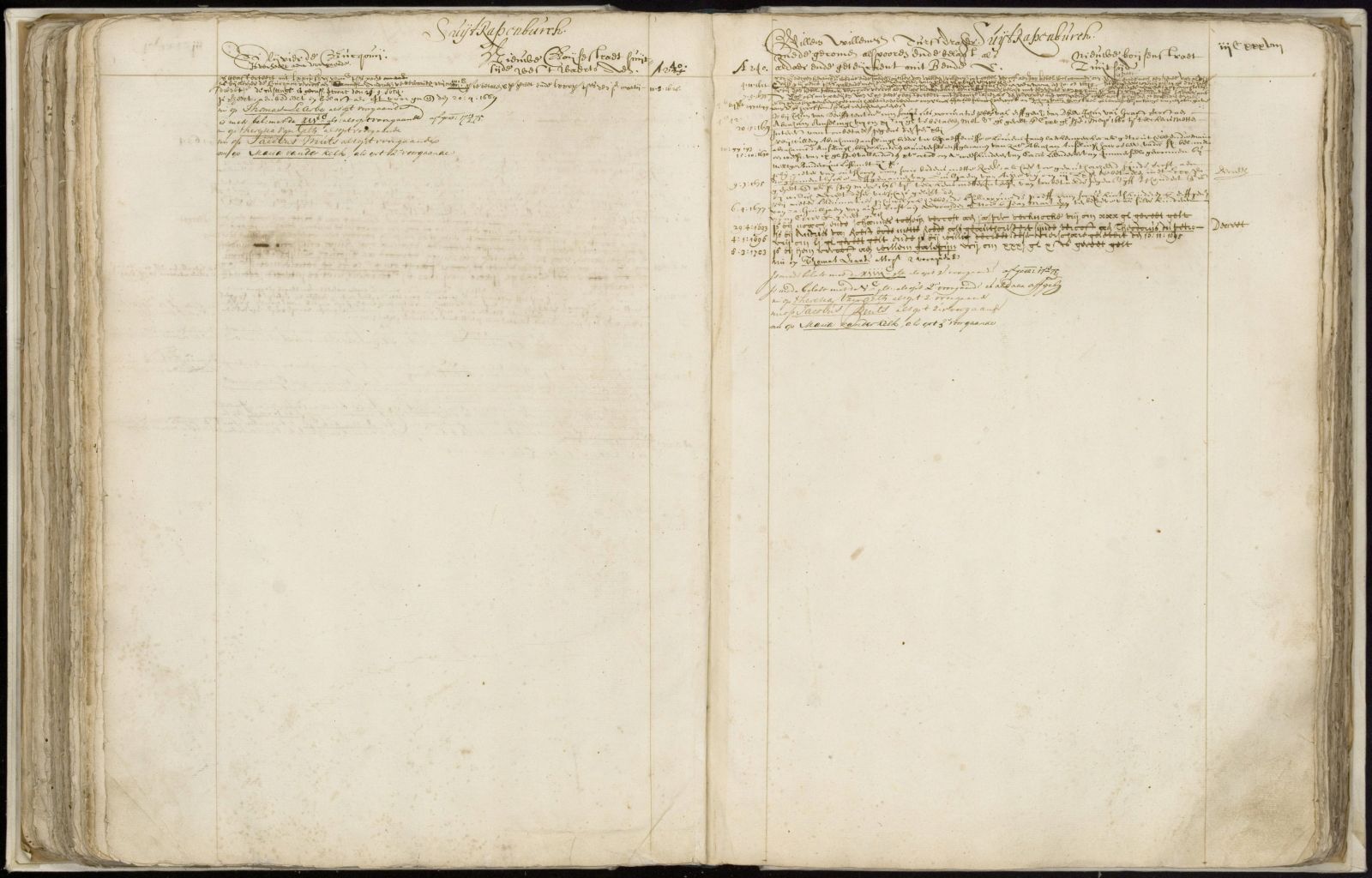
South Rapenburg. Willem Willemszoon, turf-carrier, likewise entered as above and charged as there, marked with B and C. Nieuwe Boyenstraat, south side.
4 November 1611: Sold in its entirety by Grietgen Henricxdochter, widow and executrix of the estate of Willem Willemszoon, to Jan Kebel, wool comber, for one hundred guilders in cash, plus an annuity of forty-six guilders, seventeen stuivers and eight pence yearly, falling due in May. The annuity bond of forty-six guilders, seventeen stuivers and seven pence, and the mortgage bond of five hundred and fifty guilders, [both] cancelled here, were produced on 30 August 1649.
7 September 1630: Sold by Jan Kebel, tobacco merchant, to Claes Kieckenburch, bookbinder, charged with an annuity of thirty-four guilders, seven stuivers and eight pence yearly, redeemable with five hundred and fifty guilders or in instalments of one hundred guilders, and encumbered with such charges as the seller still owes from the preceding purchase. In addition, etc.
[Marginal note:] The foregoing is a portion of the forty-six guilders, etc., according to [text unclear in the original] of the deed of conveyance.
Translation by Radicae, The Leiden Connection, from the Dutch transcription supplied by Erfgoed Leiden. This entry is drawn from the city property register (Bonboek) rather than a full notarial deed; one short phrase near the end is unclear in the source transcription.