
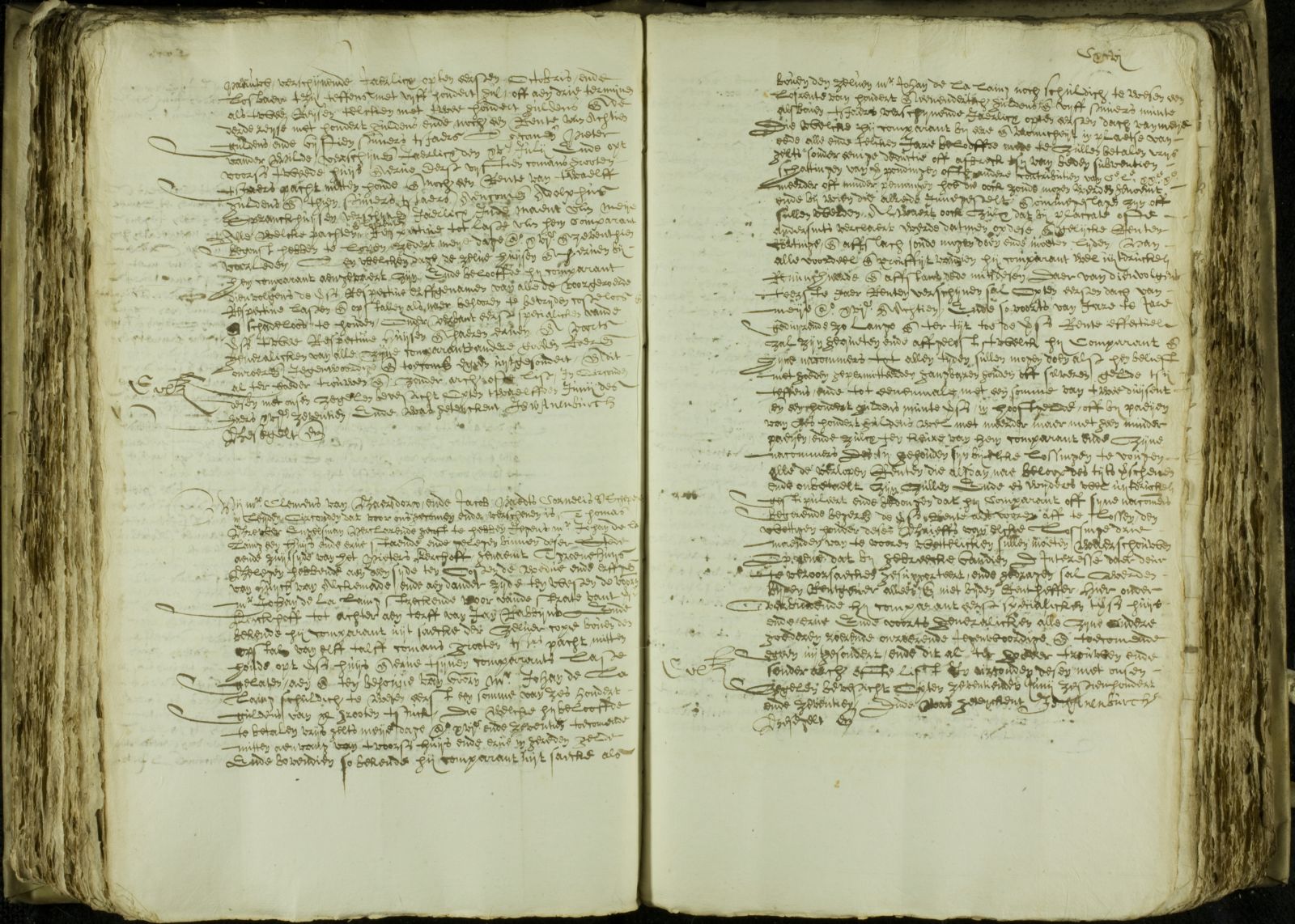
We, Master Clemens van Baersdorp and Jacob Paedts Corneliszoon, aldermen in Leiden, certify that Thomas Brewer, an Englishman, appeared before us and declared that he had purchased from Master Johan de la Laing a house and yard standing within this city on the south side of the Pieterskerkhof, called ’t Groenehuys.
On the eastern side it adjoins the widow and heirs of Huych van Alckemade, and on the western side the aforesaid Master Johan de la Laing. It extends from the street of the aforesaid churchyard at the front to the yard of Jan Rabbijns at the rear.
The appearing buyer acknowledged that, on account of this purchase and in addition to the annual ground rent of eleven and a half Flemish groten with feudal dues left upon the house and yard at his charge, he owed Master Johan de la Laing first the sum of 600 guilders of forty groten each. He promised to pay this sum in cash, free of charges, on the coming May Day of 1617, when taking possession of the house and yard.
In addition, he acknowledged that on the same account he owed Master Johan de la Laing a redeemable annual rent of 131 guilders and five stuivers, payable each year on the first day of May. In place of an oath, he promised on his honour and good faith to pay it each year free of deductions for levies, subsidies, property taxes or other contributions, whether of the hundredth, fiftieth, twentieth or tenth penny, or any greater or lesser charge, whatever it might be called and whoever might impose it, whether already introduced or imposed later. Even if an ordinance or other rule should permit or require a deduction from rents of this kind, he expressly renounced every benefit arising from it.
The first year’s rent would fall due on 1 May 1618, and thereafter each year for as long as the rent remained unpaid. The appearing buyer and his successors might redeem it at any time, if they wished, in lawful current gold or silver money, either all at once for the principal sum of 2,100 guilders or in instalments of 600 guilders or more, but not less. At every redemption they were also required to pay all accrued interest then due and unpaid.
It was expressly stipulated that, if the appearing buyer or his successors wished to redeem the rent, they must lawfully notify the lawful holder of the deed three months before each payment. If they failed to do so, any loss of interest thereby caused would be borne by the rent payer alone and not by the rent receiver.
For this obligation the appearing buyer specially pledged the house and yard, and generally all his other movable and immovable goods, present and future, none excepted. All this was done in good faith and without fraud.
In witness, this deed was confirmed with our seals on 17 June 1617. It was signed J. Swanenburch and sealed, etc.
Translation by Radicae, The Leiden Connection, from the Dutch transcription supplied by Erfgoed Leiden.