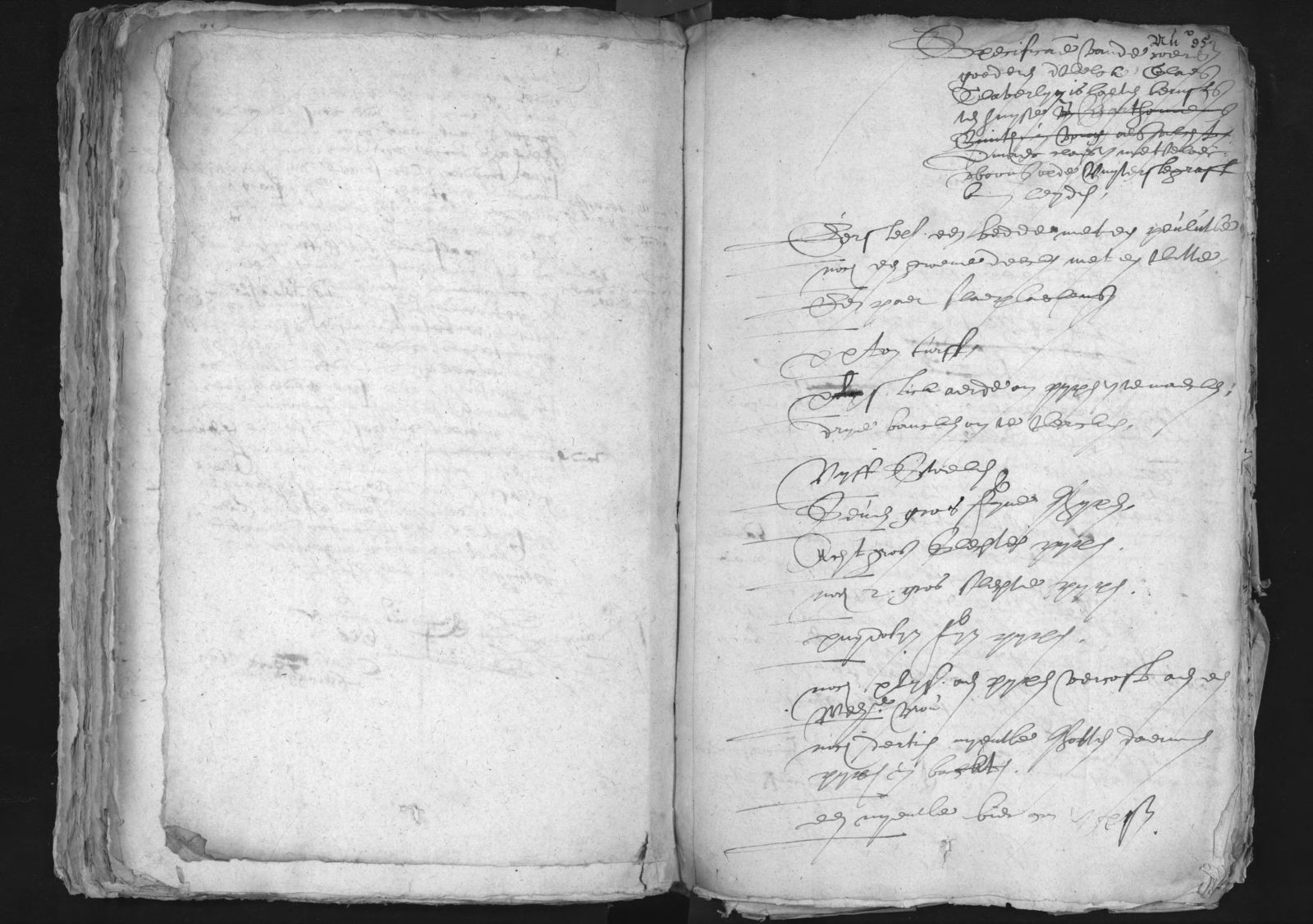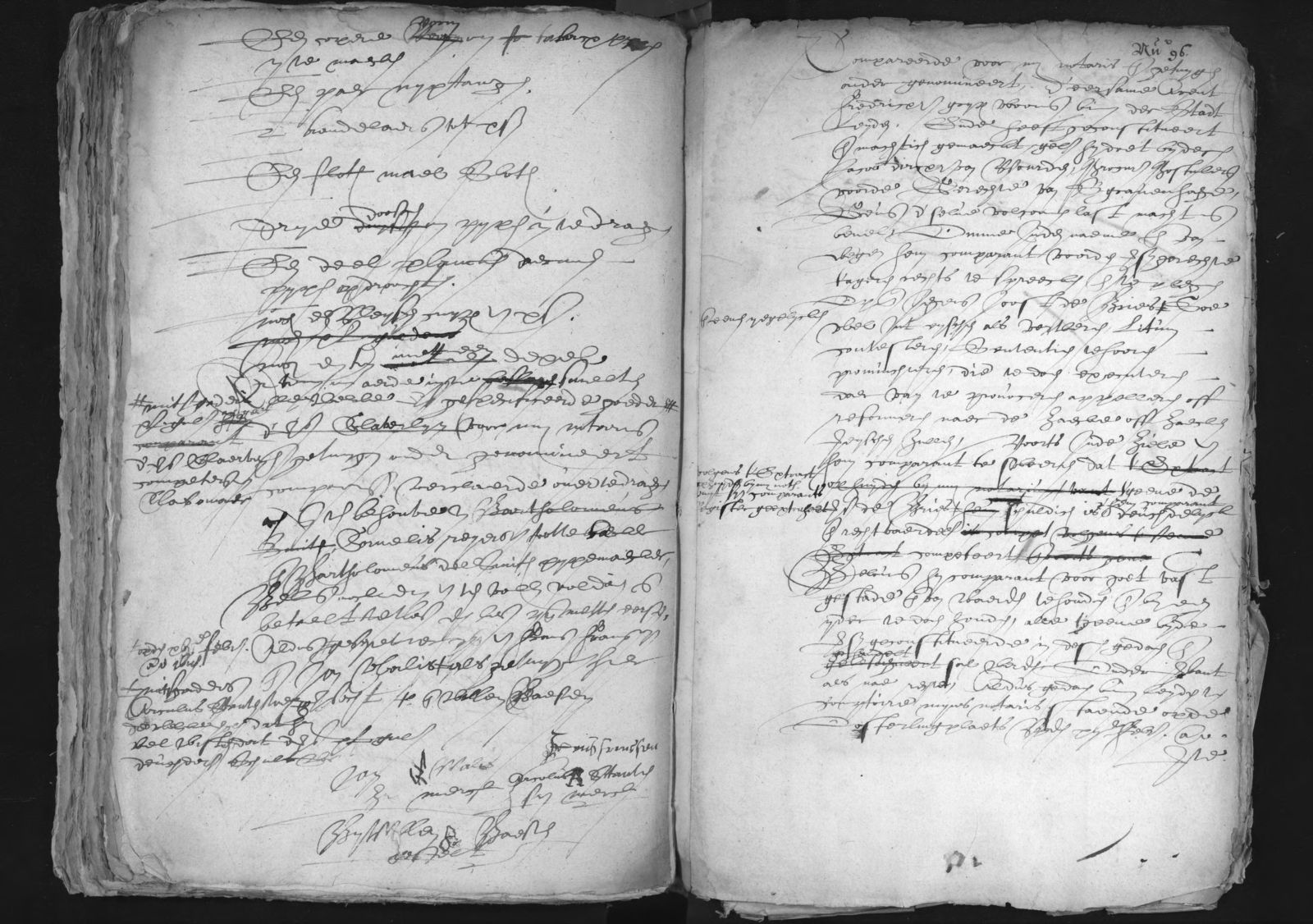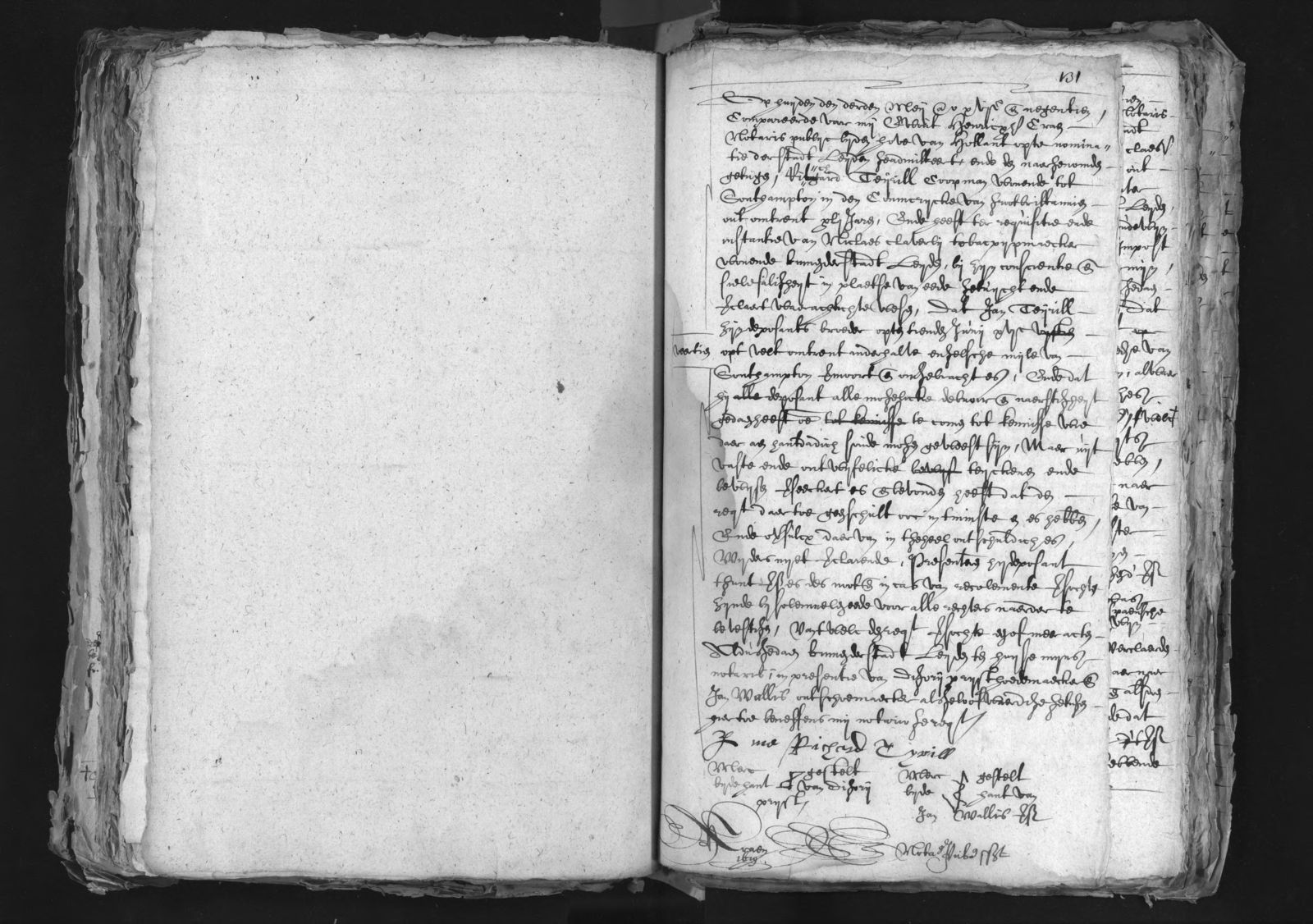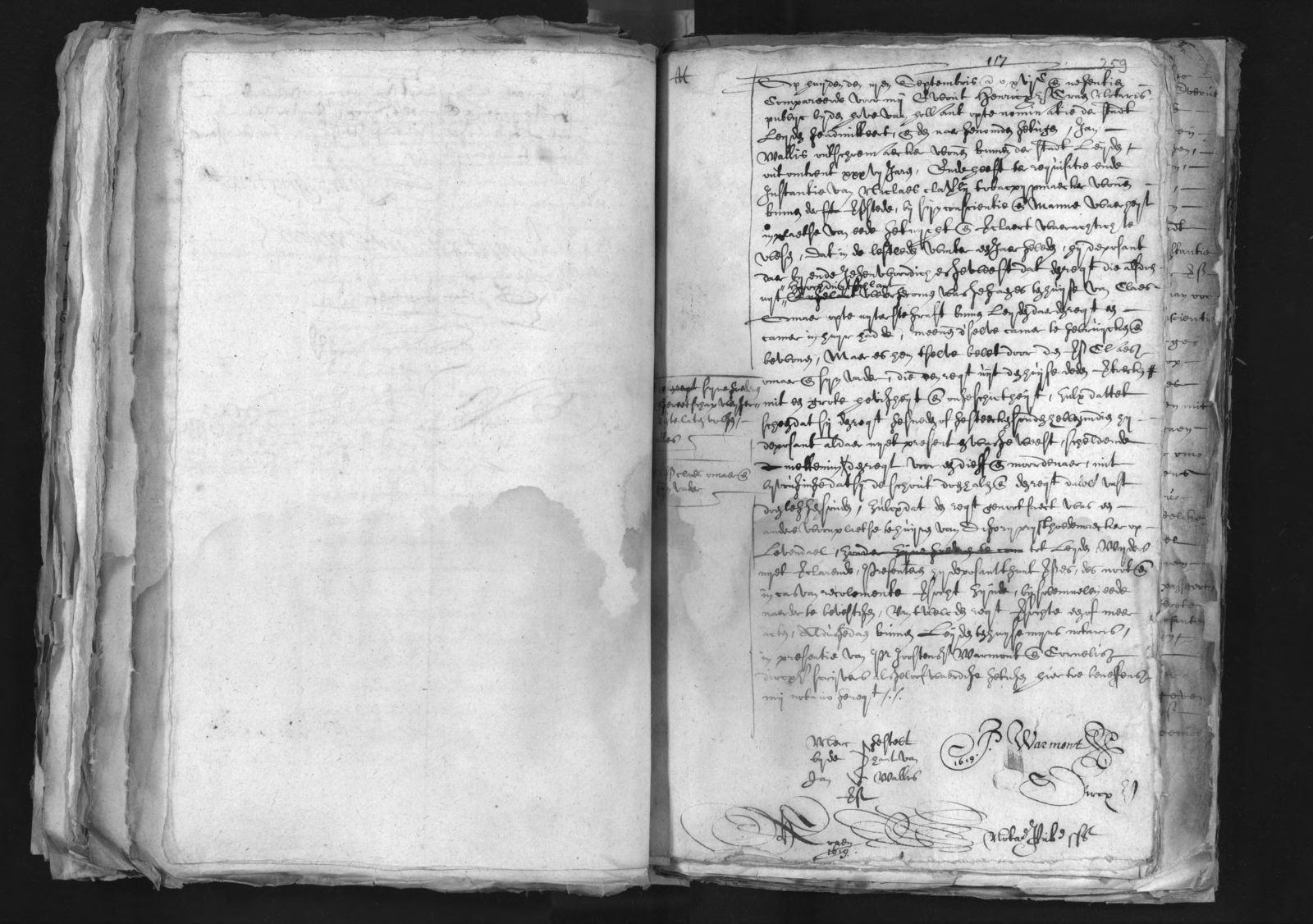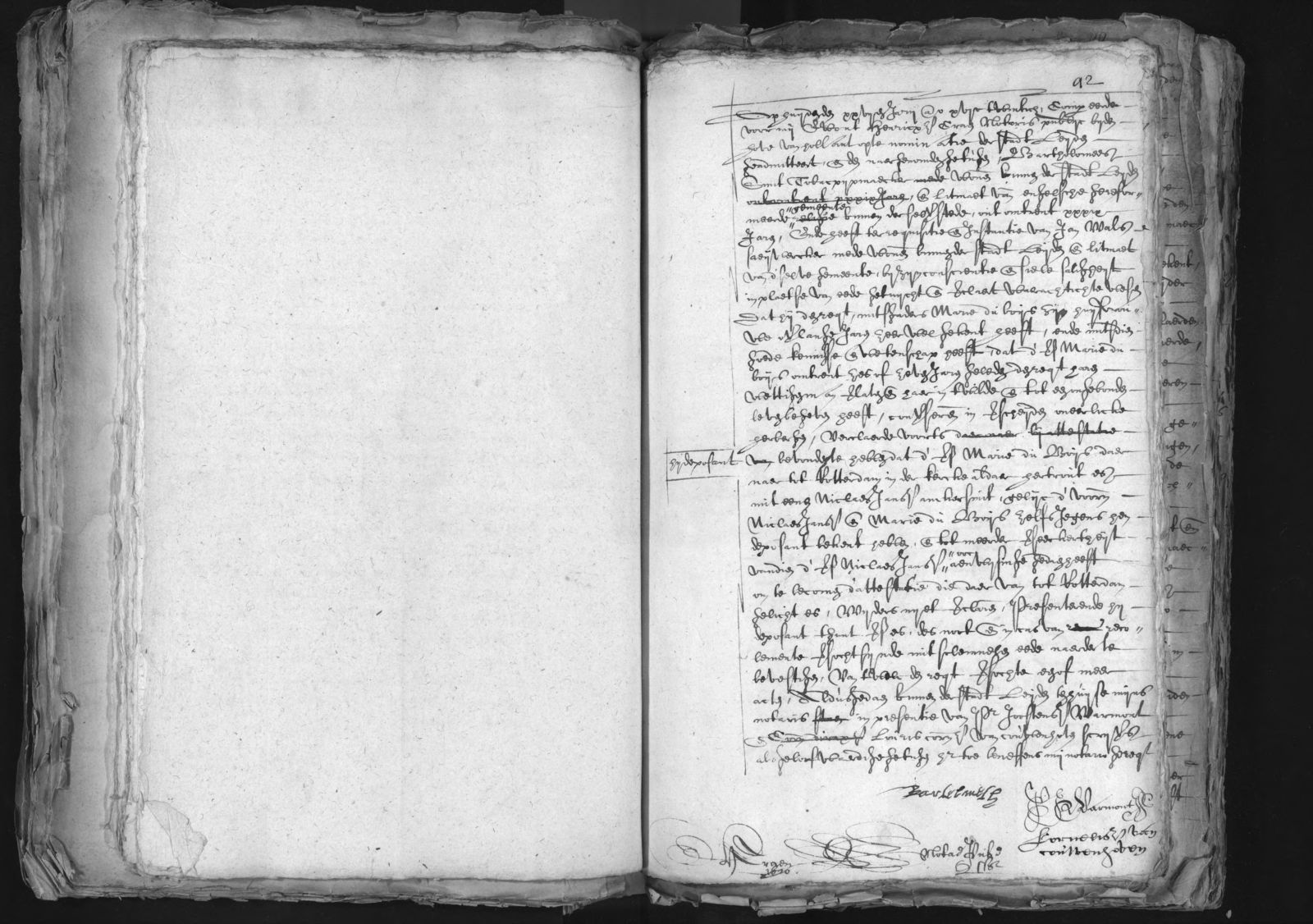
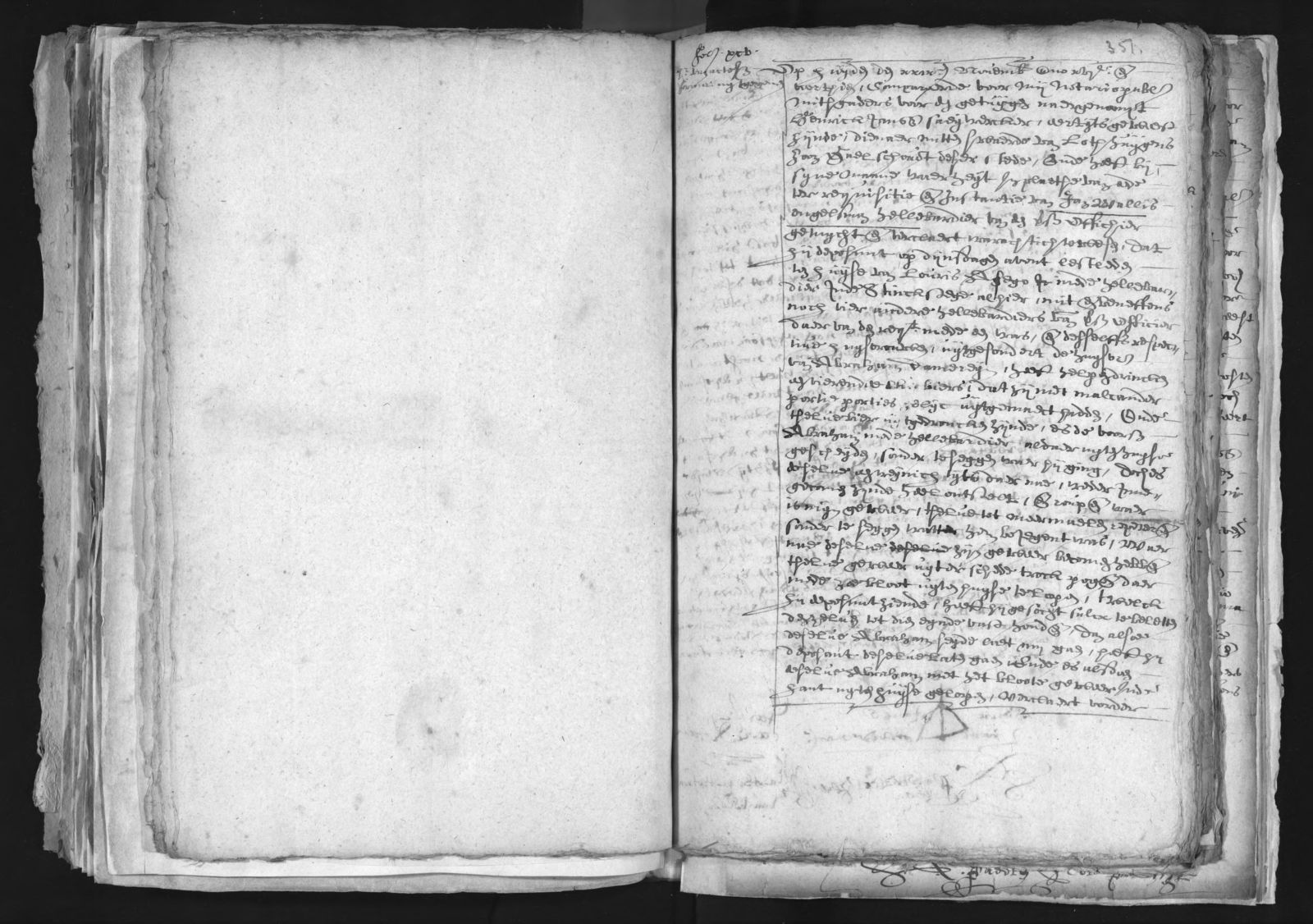
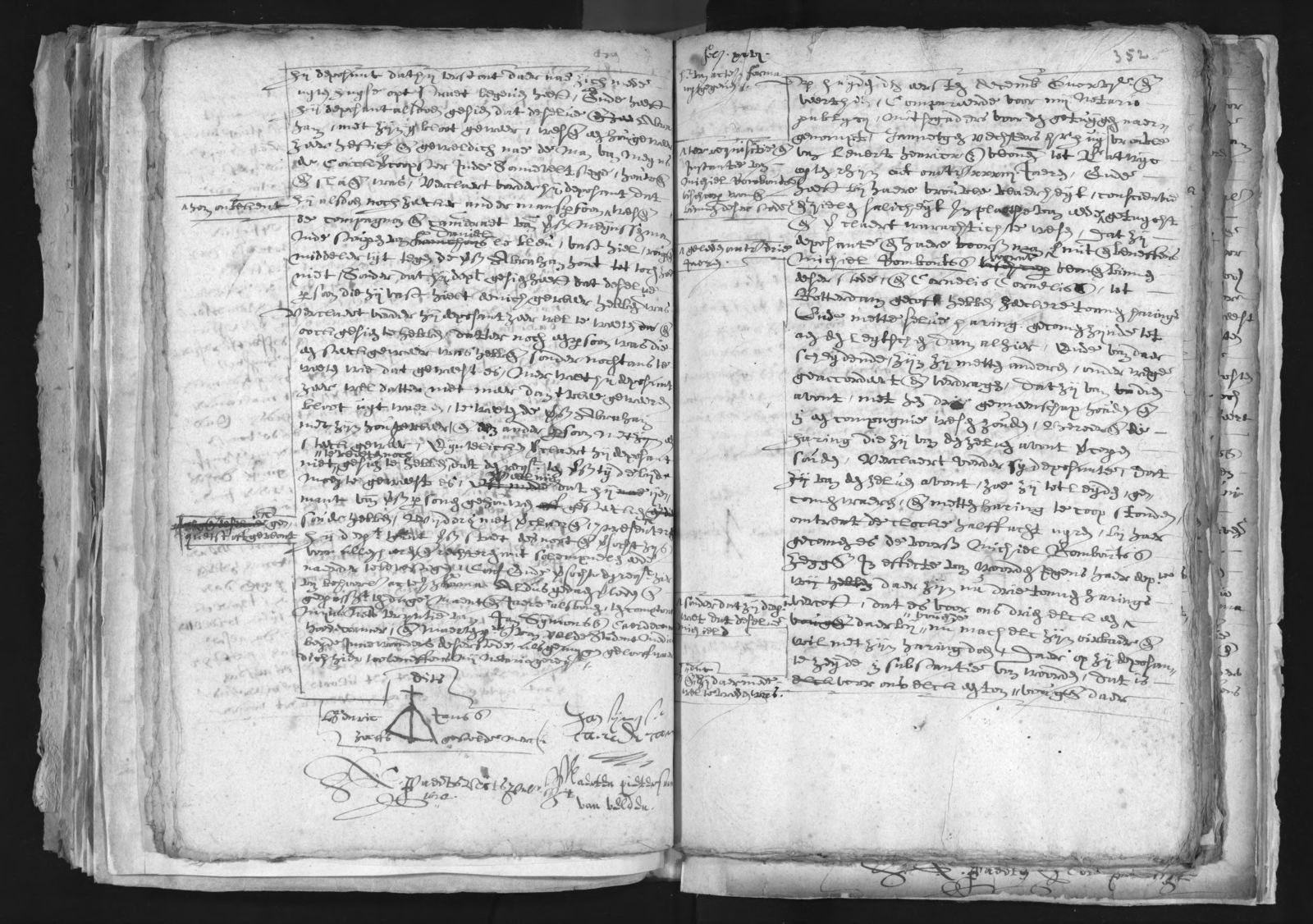
Today, the 29th of November in the year 1614, there appeared before me, notary public, together with the undersigned witnesses, Henrick Janszoon, serge worker, formerly a sword-bearing officer (serjeant) of Loth Huygenszoon Gael, bailiff of this city.
And he, in place of an oath, upon his word as a man, at the request and instance of Jan Wallis, Englishman, halberdier of the aforesaid officer, testified and declared to be true: that he, the deponent, on Tuesday evening last, at the house of Louris Asego, likewise a halberdier, in the Stinksteeg here, together with four other halberdiers of the aforesaid officer, of whom the requester was also one, and their respective wives, except the wife of Abraham Damereyn, helped to drink a quarter of [the original reads only "k...biers", the word is damaged — probably a can or pot of beer], which they had together made up in equal shares.
Before that beer had been finished, the aforesaid Abraham, likewise a halberdier, parted from the company there and left the house without saying where he was going; but after a short while he came back in again, quite agitated, calling out 'where is my weapon,' repeating this several times without saying what had happened to him; and having obtained his weapon, he drew it from its sheath, attempting to run out of the house with it bared. Seeing this, the deponent sought to prevent it, holding him fast to that end; but since the said Abraham said 'let me go,' the deponent let him go, and thereupon the said Abraham ran out of the house with the bared weapon in his hand. The deponent further declares that he himself immediately afterward also went out of the house into the street.
And the deponent then saw that the said Abraham, with his bared weapon — being a cutting weapon (hanger) — was very fiercely and violently hacking and striking at the husband of Meyns, the cake-seller, in the Sonneveltsteeg.
The deponent further declares that at that time a certain other man, unknown to him, being the companion and comrade of the aforesaid husband of Meyns, was being held fast in the doorway of Daniel le Bleu, while calling out to the aforesaid Abraham words that appear in the original as "hout tot toch zoe niet" [this phrase is garbled/damaged in the source and its precise sense is uncertain — it appears to be an appeal such as "stop, do not do that"], without the deponent having seen that the person he was holding fast had any weapon.
The deponent further declares that he knows very well, and also saw, that there was yet another person who had a thrusting weapon, without however knowing who that was. But the deponent knows very well that there were no more than two weapons drawn, namely the aforesaid Abraham with his cutting weapon, and another person with a thrusting weapon.
Finally, the deponent declares that he does not know, nor did he see, that the requester was present at the aforesaid disturbance at that time, still less that he had struck, stabbed, injured, or wounded any of the aforesaid persons.
Declaring nothing further, the deponent offered, should it be necessary and should he be asked, to confirm the aforesaid further before all courts and judges by solemn oath; and the requester requested a proper instrument in due form hereof.
Thus done, executed, and passed on the day, month, and year as above, at the office of me, the notary, in the presence of Jan Symonszoon Caerdecam, [the original reads "hoede…mer", damaged — probably "hoedemaecker", hatter], and Maerten Pieterszoon van Velde, student of medicine, both residents of this city, as trustworthy witnesses hereto required together with me, the notary. This is the mark set by Henric Janszoon himself. Jan Symense Caerdecam. A. Paedts, notary public, 1614. Maerten Pietersoon van Velden.
Translation by Radicae, The Leiden Connection, from the Dutch transcription supplied by Erfgoed Leiden.