
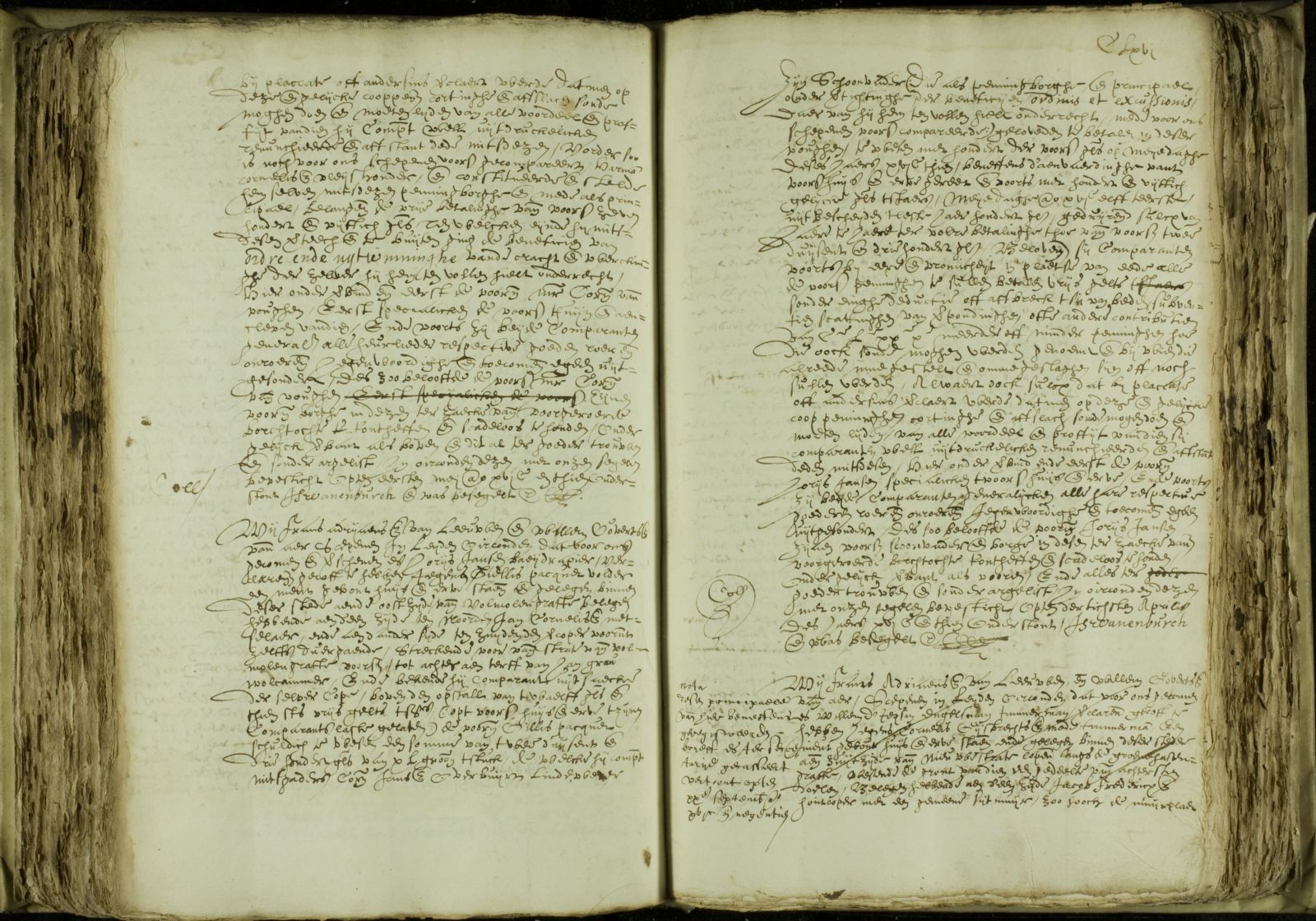
We, Frans Adriaenszoon van Leeuwen and Willem Govertszoon van der Aer, aldermen of Leiden, make known that before us came Willem de Jespin, Englishman, carpenter, declaring that he had bought from Cornelis Gijsbrechtszoon, likewise carpenter, a newly built house and grounds, standing and situated within this city on the south side of the Nieuwstraat running along the Groenhazengracht, the ground thereof being a portion of the rearmost archery-range ["doelen"], bordering on the one side on Jacob Fredericxzoon, timber merchant, with a common side wall, as high as the wall-plate of the building of the aforesaid Jacob Fredericxzoon extends, and above that the wall is free and belongs solely to this purchased house; and on the other side on Willem Robintszoon, leather-dresser, likewise Englishman, running in front from the aforesaid Nieuwstraat to the back as far as the ground of the rearmost archery-range.
And he, the appearing party, acknowledged, over and above the charge of a ground-rent of six guilders, free money, per year, left upon the aforesaid house and grounds at his, the appearing party's, own charge, to owe the aforesaid Cornelis Gijsbertszoon van Groenendael a sum of thirteen hundred guilders of 40 groats each, which he the appearing party promised to pay in this manner, namely: on May Day of the coming year sixteen hundred and ten, with the commencement of the aforesaid house and grounds, one hundred and fifty of the aforesaid guilders in cash, and thereafter yearly, on each following May Day, one hundred guilders, except that in the last year fifty guilders, continuing thus from year to year until the full payment of the aforesaid sum of thirteen hundred guilders.
He, the appearing party, further promised, on his honor and integrity in place of an oath, to pay all the aforesaid moneys in free money without any deduction or reduction, whether for aids, subsidies, assessments, land-tax levies, or other contributions of a hundredth, a fifth, a tenth, or more or fewer pennies, however they may be named, and by whomsoever they have already been imposed and assessed, or shall be, even should it be declared by placard or otherwise that a discount or reduction should or must be allowed on these and similar purchase moneys — of all benefit and advantage of which he the appearing party expressly renounced and hereby relinquished.
Furthermore there also appeared before us, the aforesaid aldermen, the aforesaid Willem Robintszoon, leather-dresser, who constituted and made himself hereby surety in money and also as principal, concerning the free payment of the aforesaid sum of thirteen hundred guilders, on behalf of the aforesaid Willem de Jepsin, renouncing and setting aside for this purpose the benefits of order and of prior execution [i.e. requiring the debtor be pursued first], the force and effect of which he declared himself fully informed of; binding hereunder, first, the aforesaid Willem de Jepsin specifically as to the aforesaid house and grounds, and further, both appearing parties generally, all their respective goods, movable and immovable, present and future, rights and debts receivable, none excepted; in consideration whereof the aforesaid Willem de Jepsin promised to relieve his aforesaid surety in this matter, on account of the aforesaid suretyship, without cost or damage, under the like obligation as above.
And all this in good faith and without deceit or guile. In witness whereof this is confirmed with our seals, on the 28th of April in the year sixteen hundred and ten. Below was written: J. Swanenburch, and it was sealed, etc.
In the margin: Note, this original of the deed registered alongside here was shown cancelled at the secretary's office on the 20th of September in the year sixteen hundred and nineteen.
Translation by Radicae, The Leiden Connection, from the Dutch transcription supplied by Erfgoed Leiden.