
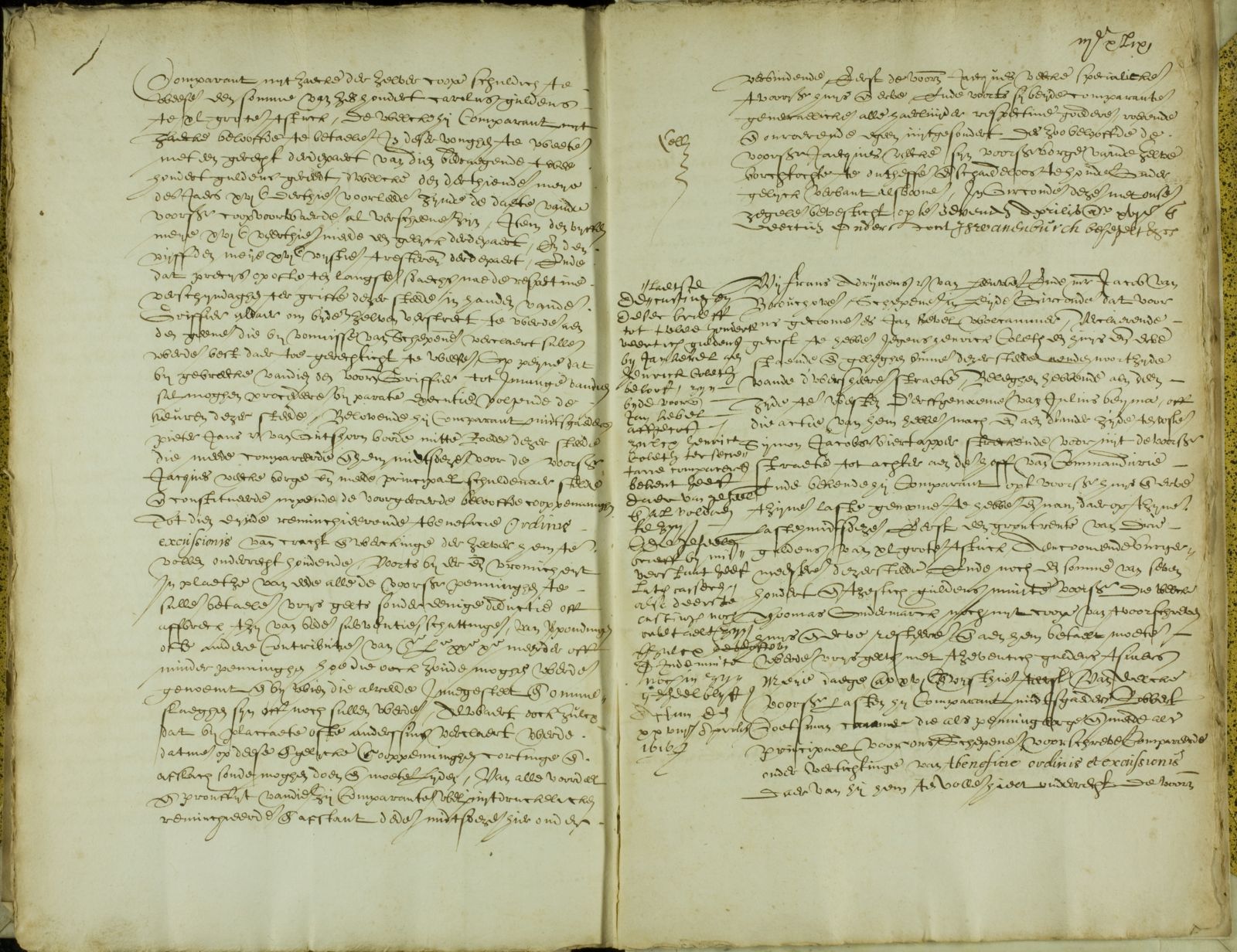
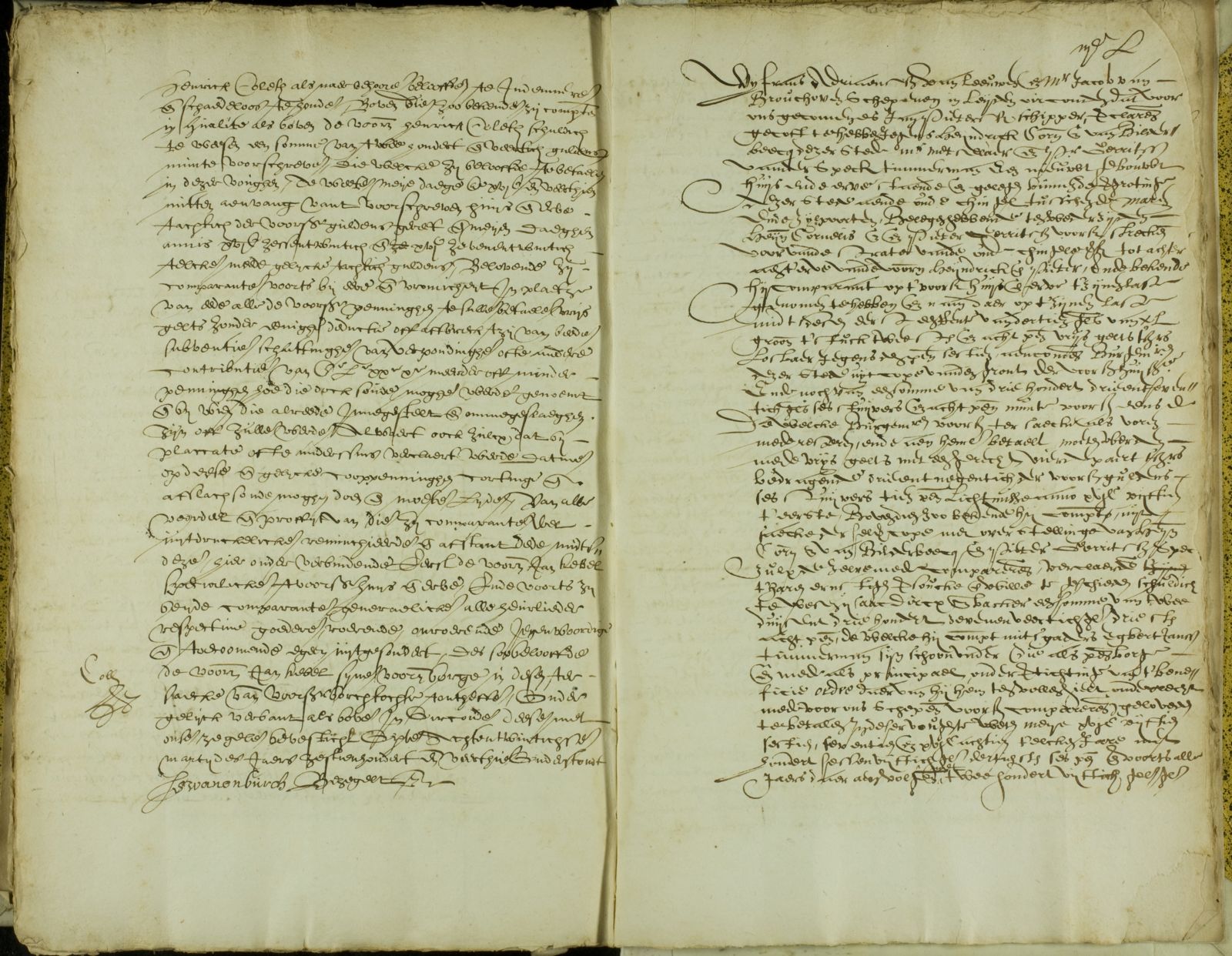
We, Frans Adryaenszoon van Leeuwen and master Jacob van Brouchoven, aldermen in Leiden, declare that there appeared before us Jan Kebel, wool comber, who declared that he had bought from Henrick Coleth a house and yard standing and situated within this city on the north side of the Dwersheerenstraete, bordered on the one side, to the west, by the heirs of Julius Beyma, or whoever may hold their claim, and on the other side, to the east, by Symon Jacobszoon, beer-tapster, running in front from the aforesaid street to the rear as far as the garden of the commandery; and the appearer acknowledged that he had taken upon himself the charges on the aforesaid house and yard.
He thereby took upon himself, first, a ground rent of three guilders of 40 groats each, due to the burgomasters of this city, and further a sum of seven hundred and sixty guilders of the aforesaid currency which Thomas Ondermarck still had outstanding from the sale of the aforesaid house and yard, to be paid to him in free money together with seventy guilders per year, at May-day of the year sixteen hundred and fifteen for the first payment. Of these aforesaid charges the appearer, together with Robbert Coetsman, comber, who appeared before us aldermen as surety for the debt and likewise as principal, waiving the benefit of order and of execution (ordinis et excussionis), of which he declared himself fully informed, promised to indemnify and hold harmless the aforesaid Henrick Coleth as is fitting.
Beyond this, the appearers, in the capacity aforesaid, acknowledged owing to the aforesaid Henrick Coleth a sum of two hundred and forty guilders of the said currency, which they promised to pay in this manner: namely, at May-day of the year sixteen hundred and fourteen, at the taking of possession of the aforesaid house and yard, eighty of the said guilders in cash, and at May-day of the years sixteen hundred twenty-six and sixteen hundred twenty-seven, likewise eighty guilders each time.
The appearers further promised, on their honour and good faith, in place of an oath, to pay all the aforesaid moneys in free money without any deduction or reduction, whether for aids, subventions, assessments, land taxes (verpondingen), or other contributions of a hundredth, fiftieth, twentieth, tenth part or more or fewer pennies, however these might be named, and by whomever they have already been imposed and levied or shall be imposed — even should it be declared by placard or otherwise that on these and similar purchase moneys a reduction or discount should or must be allowed — of all advantage and benefit of which the appearers expressly renounced and waived hereby, hereby binding, first, the aforesaid Jan Kebel specifically with the aforesaid house and yard, and further both appearers generally with all their respective goods, movable and immovable, present and future, none excepted.
The aforesaid Jan Kebel further promised to release his aforesaid surety in this matter from the said suretyship, under the same binding as above. In witness whereof this is confirmed with our seals, on the twenty-eighth of March in the year sixteen hundred and fourteen. Signed below: J. Swanenburch. Sealed, etc.
In the margin: The last bond of this deed, for two hundred and forty guilders, promised by Jan Kebel to Henrick Coleth, has been redeemed by the aforesaid Jan Kebel, such that Henrick Coleth, appearing at the secretary's office, acknowledged himself fully and entirely paid thereof, and through misunderstanding had the whole deed cancelled — whereas the first bond still remains unpaid, so that the promise of indemnity remains still in full force. Done the 28th of April 1616.
Translation by Radicae, The Leiden Connection, from the Dutch transcription supplied by Erfgoed Leiden.