
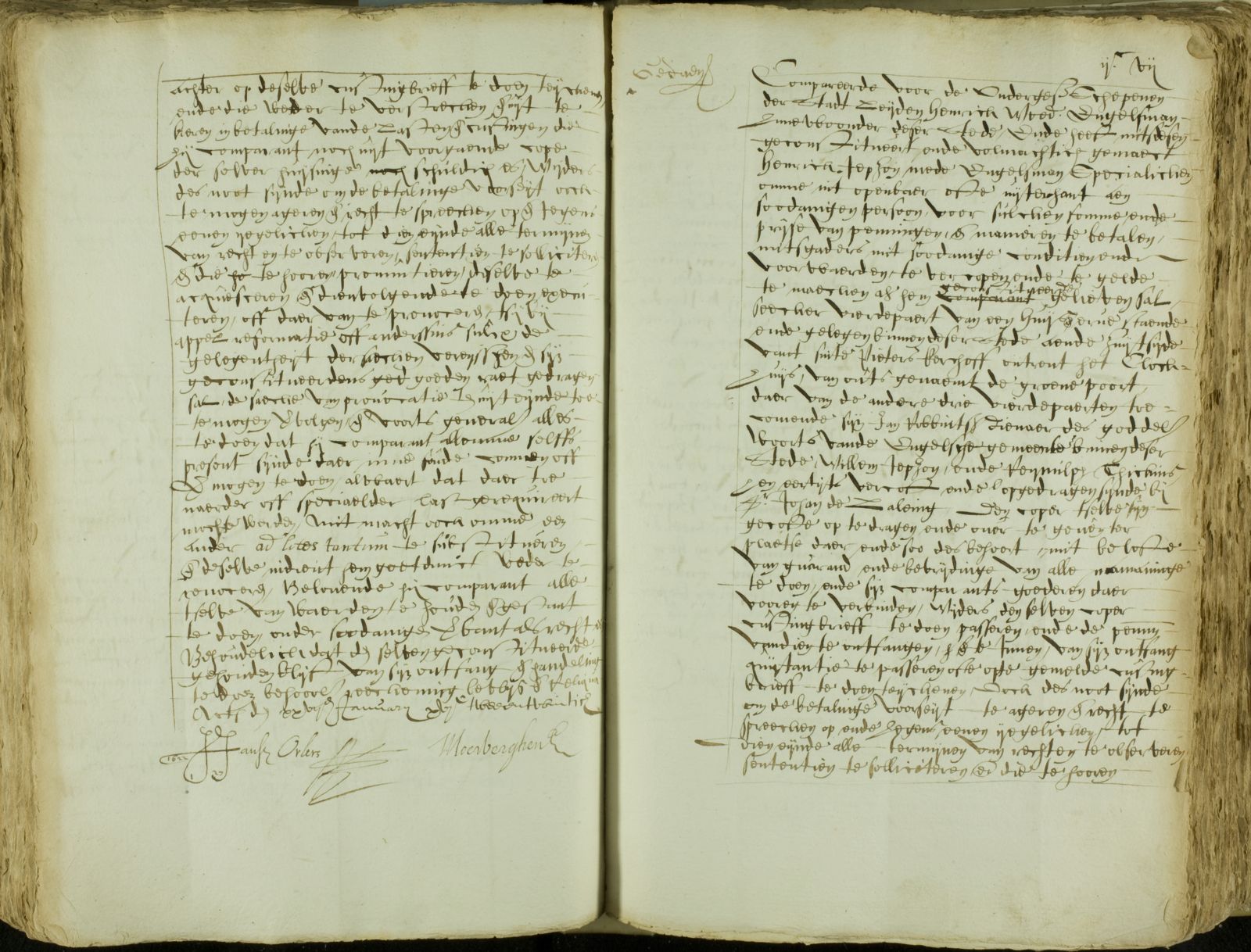
Henrick Woed, an Englishman and inhabitant of this city, appeared before the undersigned aldermen of Leiden. By this deed he appointed and fully authorised Henrick Jepzon, likewise an Englishman, especially to sell and convert into money, either publicly or privately, to such person, for such sum and price, in such manner of payment and upon such conditions as the authorised representative should think fit, a certain quarter share of a house and yard standing within this city on the south side of Saint Peter’s Churchyard near the Clockhuys, long known as De Groene Poort.
The other three quarter shares belonged to Jan Robbintsz, minister of the Divine Word to the English congregation in this city, Willem Jepzon and Reynulph Thickins. The property had formerly been sold and conveyed to them by Seigneur Johan de Laleing.
The authorised representative was empowered to convey and transfer the purchased share to the buyer in the proper place and manner, with a promise of warranty and indemnity against every later claim, and to pledge the appearing principal’s goods for that purpose. He was further empowered to have the buyer execute a mortgage deed, to receive and collect the purchase money, and to issue a receipt for it or have the payment endorsed upon the mortgage deed.
If necessary, he might bring and conduct legal proceedings concerning the payment against any person, observe all legal terms, apply for judgments and hear them pronounced, accept them and have them executed, or appeal from them by appeal, reformation or otherwise, as the circumstances required and good counsel advised, and pursue any appeal to its final conclusion.
Generally, in all the foregoing matters, he might do everything that the appearing principal could have done if personally present everywhere, even if a more particular or special authority than that stated above should be required. He was also empowered to substitute one or more persons for litigation only and, if he thought fit, to revoke them.
The appearing principal promised to hold valid and to perform everything done and transacted in the foregoing matters by his authorised representative or any substitute, under such pledge as the law requires. The representative remained obliged, upon demand by the principal, to render and deliver a proper account, proof and balance of his receipts and actions.
Done on 2 February 1622. Jansz Orlers; 2 February 1622; Moerberghen.
Translation by Radicae, The Leiden Connection, from the Dutch transcription supplied by Erfgoed Leiden.